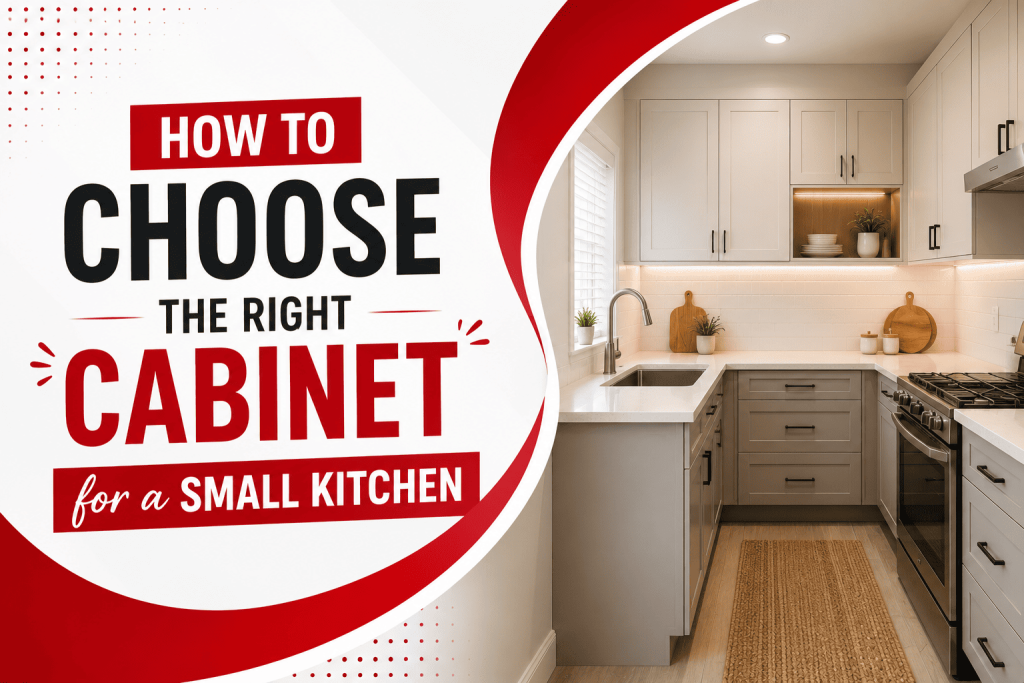
A small kitchen doesn’t have to feel cramped or cluttered — but the wrong cabinet choices can make it feel exactly that way. The good news is that cabinet selection has more impact on how a small kitchen feels than almost any other element. Get it right, and a compact space can function just as well as a large one.
Here’s what to focus on when you’re working with limited square footage.
Start With Layout, Not Style
Before you think about finishes or door styles, figure out your layout. In a small kitchen, every inch of wall space is storage potential. The most common mistake is treating upper and lower cabinets as separate decisions — they need to work together as a system.
Floor-to-ceiling cabinetry is one of the smartest moves in a tight kitchen. Running cabinets all the way up to the ceiling eliminates the dead space above standard upper cabinets — that awkward gap that collects dust and rarely stores anything useful. If full-height cabinets aren’t possible, even adding a second row of smaller cabinets above your standard uppers reclaims real storage.
Choose Flat-Panel or Shaker Doors
In a small space, cabinet doors are a dominant visual element. Ornate raised-panel doors with heavy molding add visual weight — which is the last thing a compact kitchen needs. Flat-panel (slab) doors or simple shaker-style doors keep the eye moving without stopping on busy details.
Flat-panel doors in particular make a small kitchen feel more like a single cohesive unit rather than a wall of individual boxes. That visual calm makes the room feel larger than it is.
Browse our kitchen cabinet styles to compare flat-panel and shaker options side by side.
Go Light on Color — With a Few Exceptions
Light-colored cabinets reflect available light and make a small kitchen feel more open. White, off-white, light grey, and pale wood tones are all solid choices for perimeter cabinets in a compact space. They’re not the only option, but they do the most to counter a kitchen feeling closed in.
That said, a darker lower cabinet with light uppers — a two-tone approach — can work well even in smaller kitchens. It adds visual interest without making the whole room feel heavy, since the darker color stays low and grounded.
Not sure which color direction will work in your space? Book a visit and bring photos — it’s much easier to evaluate against your actual lighting and existing finishes.
Prioritize Interior Storage Features
The outside of a cabinet gets all the attention, but the inside is where a small kitchen wins or loses. Standard shelving in base cabinets wastes a surprising amount of space — items get pushed to the back and forgotten. In a small kitchen, you can’t afford that.
Look for or add these interior features when selecting cabinets:
- Full-extension pull-out shelves in base cabinets — you can see and reach everything without crouching
- Drawer-in-drawer base cabinets — stack small items in a top tray above larger items below
- Tall pull-out pantry units — narrow and vertical, these fit in gaps other cabinets can’t use
- Corner solutions — lazy susans or pull-out corner units instead of dead corner space
- Drawer base cabinets instead of door-and-shelf bases wherever possible — drawers are far more accessible for pots, pans, and everyday items
These features make a real difference in daily use — not just on the day you move in, but years down the line when the novelty of a fresh kitchen has worn off and function is all that matters.
Skip the Upper Cabinets in One Section
This sounds counterintuitive for a small kitchen, but leaving one wall section free of upper cabinets — or replacing them with open shelving for a few key items — can make a tight kitchen feel significantly less boxed in. The visual break gives the eye somewhere to rest and creates a sense of depth.
The key is being strategic about where you make this trade-off. Over the sink or a window wall is usually the best spot — you’re not losing much practical storage since those areas are often awkward to reach anyway.
Think About Hardware Carefully
In a small kitchen, hardware is visible everywhere at once. Handles and pulls that are too large or too decorative add clutter. Simple bar pulls, slim edge pulls, or handleless push-to-open mechanisms keep the surface clean and the room feeling organized.
Matching hardware finish to your faucet and appliance handles also helps the room feel intentional rather than assembled from separate decisions.
Don’t Overlook the Space Above the Fridge and Stove
These spots are often left open by default — but in a small kitchen, they’re free storage. A cabinet above the refrigerator (even a shallow one) is perfect for bulky, low-use items like large serving trays, seasonal appliances, or extra pantry stock. A shallow cabinet above the range hood can hold spices or small items close to where you cook.
Quality Matters More in a Small Kitchen
In a large kitchen, one or two poorly constructed cabinets might go unnoticed. In a small kitchen, every cabinet is used constantly — drawers open and close dozens of times a day, hinges are always in motion. Cheap construction shows up faster and frustrates more in a compact, high-use space.
Plywood box construction, soft-close hinges, and full-extension drawer glides are worth prioritizing — they’re not luxury features, they’re what separates a cabinet that holds up from one that doesn’t. Take a look at our cabinet shop to see construction details on the lines we carry.
See Real Examples Before You Decide
Small kitchens are harder to visualize from product photos alone. Door samples and finish swatches help, but seeing completed installations gives you a much better sense of how a style actually reads in a real space. Check out our project gallery for examples across different kitchen sizes and layouts.
Choosing cabinets for a small kitchen is less about picking a style you like and more about building a system that makes the space work hard. The right combination of layout, door style, interior features, and finish can turn a kitchen that feels too small into one that feels considered and purposeful.
MNK Cabinet carries a range of cabinet options suited for smaller kitchens — from full-height units to drawer base configurations. Reach out if you’d like help figuring out what will work best in your space.